

 I alt: 1088
 Medlemmer: 2
 Skjulte: 0
 Gæster: 1086


Regardless of whether your goal is to get bigger, get stronger, or to simply shed some body fat, learning how to deadlift properly can help you achieve your goal faster.
Unfortunately, a lot of people have no clue how to deadlift properly, and as such, end up getting injured.
In this article, you’ll learn how to deadlift with great technique so that you can achieve your goals and stay healthy to boot!
Before we get into the technique, though, let’s start with some of the major benefits of incorporating deadlifts into your training session.
Benefits of Deadlifting
Get stronger
For most guys, this one is a no-brainer – you want to deadlift heavy things so you can get stronger.However, I would argue that many women could reap a lot of strength benefits from deadlifting as well. Trust me, you’re not going to get big and bulky unless you eat garbage. Instead, what you’ll find is that deadlifting helps you build muscle in some keys areas that most women actually want to develop (more on this below).
Develop the glutes, hamstrings and lower back
For guys, this may not be the focal point of their programming, but let’s be honest – most women don’t mind if you’ve built yourself a backside!Women, on the other hand, often want to develop this area, which is why we’re forced to hear about cardio classes like “Bunz and Gunz.”If your goal is to develop a rock-solid and sexy backside, the deadlift can you get there faster and more effectively than any and all of the toning classes you take combined.
Improved sports performance
Look at almost any great strength/power athlete, and you’ll see a well put together backside.The glutes, hamstrings and lower back are critical for running faster, jumping higher (or further), and in general, being awesome. If you want to be a stud athlete, you owe it to yourself to train your posterior chain.
Prevent injury
Finally, I don’t care what your goal is – it sucks if you’re sitting on the sidelines due to injury.The glutes and hamstrings play a critical role in not only knee but lower back health as well. With regards to knee health, strong glutes and hamstrings can help prevent overuse injuries such as patello-femoral pain, patellar tendinosis, as well as traumatic injuries like ACL tears.
Along those same lines, a strong posterior chain can help keep your back healthy as well. Too often, people want to use their back and only their back to lift pick things up off the ground. This is how an often benign day of household chores can land you in your bed for the next 7 days chewing ibuprofen like it’s candy.By strengthening the glutes and hamstrings, along with learning how to deadlift properly, you’ll be much less likely to injure your lower back in the future.
How To Deadlift – The Set-up
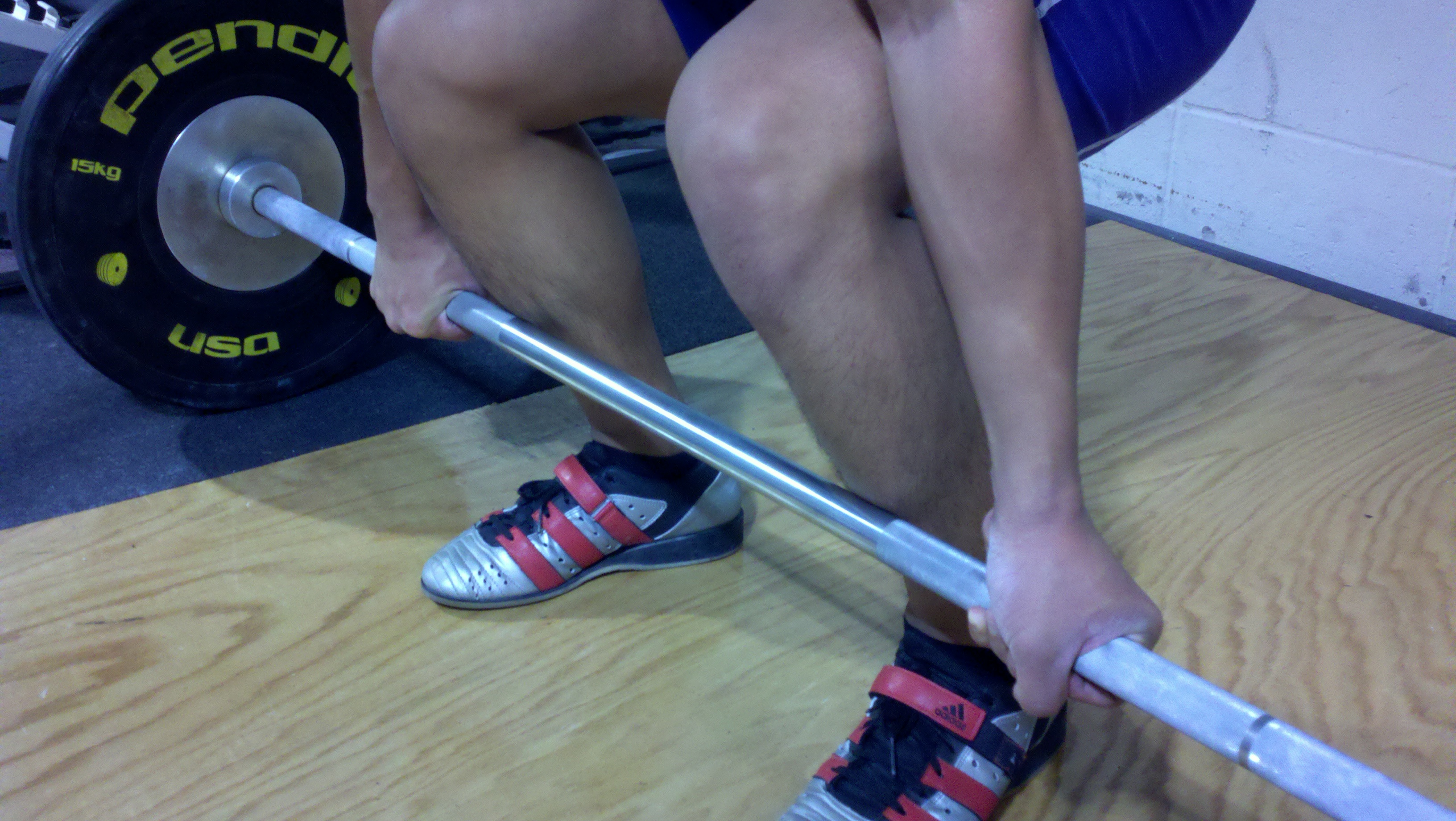
Get Your Shins Close
One of the biggest errors you’ll see when deadlifting is when people try to squat the weight. A deadlift is a more hip-dominant movement, meaning you’ll want to focus on developing the glutes and hamstrings, also known as your posterior chain.
I like to coach my lifters to “crowd” the bar with their shins. If your shins are too far back, you’ll end up shifting the ankles way forward, getting the hips too low, and essentially squatting the weight up.
Tripod Foot
To properly engage and recruit all the appropriate muscles, we need to have a strong and stable foot. A tripod foot position is where your body weight is balanced between your 1st metatarsal head, your 5th metatarsal head, and your heel.
You’ll often see people lose this balance between the three points when lifting. If you’d like more info on tripod foot, simply check out the video below.
Big Breath
Once your shins are in the right position, take a deep belly breath. This will activate your diaphragm, and increase intra-abdominal pressure. Forgot about trying to breathe in and out while lifting; if you’re going to lift something relatively heavy off the floor, you need to take a deep breath and hold it to keep your spine stable and lower back healthy.
Hips Back
While holding your breath, push your hips back to lower yourself down to the bar.
NOTE: DO NOT simply squat down! You want to push your hips back, which will help you load your glutes and hamstrings.
Push your hips back as far as you can without rounding your lower back, and then bend the knees slightly to get you all the way down to the bar.
Chest out, Back Flat and Chin Down
As you lower yourself down to the bar, you need to focus on keeping a neutral spine position. In the case of the deadlift most people need to focus on keeping their chest up, their back flat, and their chin down.
Keeping the chest up and back flat will put you in an ideal position to lift the weight off the floor. And while it’s not discussed as frequently, keeping the chin downs (and eyes up!), will allow you to get more “pop” out of your deadlift. If your neck is looking up at the ceiling, not only do you lose glute and hamstring strength off the floor, but you will also be unable to use your glutes and hips to finish the weight at the top of the lift.
For more information on proper alignment, check out these videos:
Grab the Bar
It’s now time to grab the bar. Start with a double overhand, where both of your palms facing your body. We’ll discuss different grip variations later on.
With regards to hand placement, simply let your arms hang straight down and as you lower yourself, grab the bar with your hands in this position. Going any wider makes for an inefficient (and longer) deadlift, while going much narrower can make the lift awkward as it’s difficult to control the bar.
Lats Tight and Pull Back
As you’re gripping the bar, use your lats (the big muscles on the sides of your upper back) to pull the bar back into your shins.
While it may not be an issue with lighter weights, when the weight gets heavy the bar has a tendency to “drift” in front of your body. Not only does this have a tendency to round your lower back (and thus increase the risk of injury), but it leaves you in a horrible position to actually complete the lift.
By getting the lats tight and pulling the bar back into your shins, you improve your connection to the bar and keep it in an optimal line of pull.
For more information on getting the lats tight, check out this video:
Take the Slack Out of the Bar
Finally, before we actually lift the bar from the floor, we need to take the slack out of the bar.
Depending on the type of bar you’re lifting with, there could be huge differences in the amount of “flex” the bar has. Your average stiff powerlifting bar has a minimal amount of flex or whip, while specialty deadlift bars have a ton of flex that allows the lifter to get his/her hips higher and into a more optimal alignment before the weight breaks from the floor.
You’ll often see newer lifters who “jerk” the weight to get it started. Not only does this put a tremendous amount of strain on the biceps and lower back, but again, the bar will have a tendency to drift in front of them.
Think about pulling any slack out of the bar before you actually pick it up off the ground. This will make for a smoother and much more efficient deadlift.